Travel the Formula 1 calendar from your own kitchen. Search any driver, circuit, country or race since 1950, then bring that place to your table. No passport required, though an apron helps.
Every driver leads to a country, every country to a circuit, and every circuit, eventually, to dinner.
Where it began
My mom and I.
Every race, a seat at our table.
For almost a decade, my mom and I have kept one tradition. Wherever Formula 1 races that weekend, that is where dinner comes from. Melbourne sends us to the Australian coast. Suzuka brings Japan into our kitchen. Monza means Italy, and a very long lunch.
What began as a way to watch together became the best part of our week. A country we have never visited. An ingredient we have never bought. An hour side by side at the stove before the lights go out. Somewhere between the first course and the checkered flag, it stopped being dinner and became ours.
For years we joked that it should be a cookbook. Now we are writing it, together, one race at a time.
Podium Plates is more than a book to us. It is a reason to keep building something side by side, to keep learning the places we have only seen on a screen, and to follow this sport a little closer with every season. Support it, and you are not only backing a cookbook. You are pulling up a chair at our table, and coming along for whatever comes next.
Every contribution goes toward researching, writing and printing the first edition.
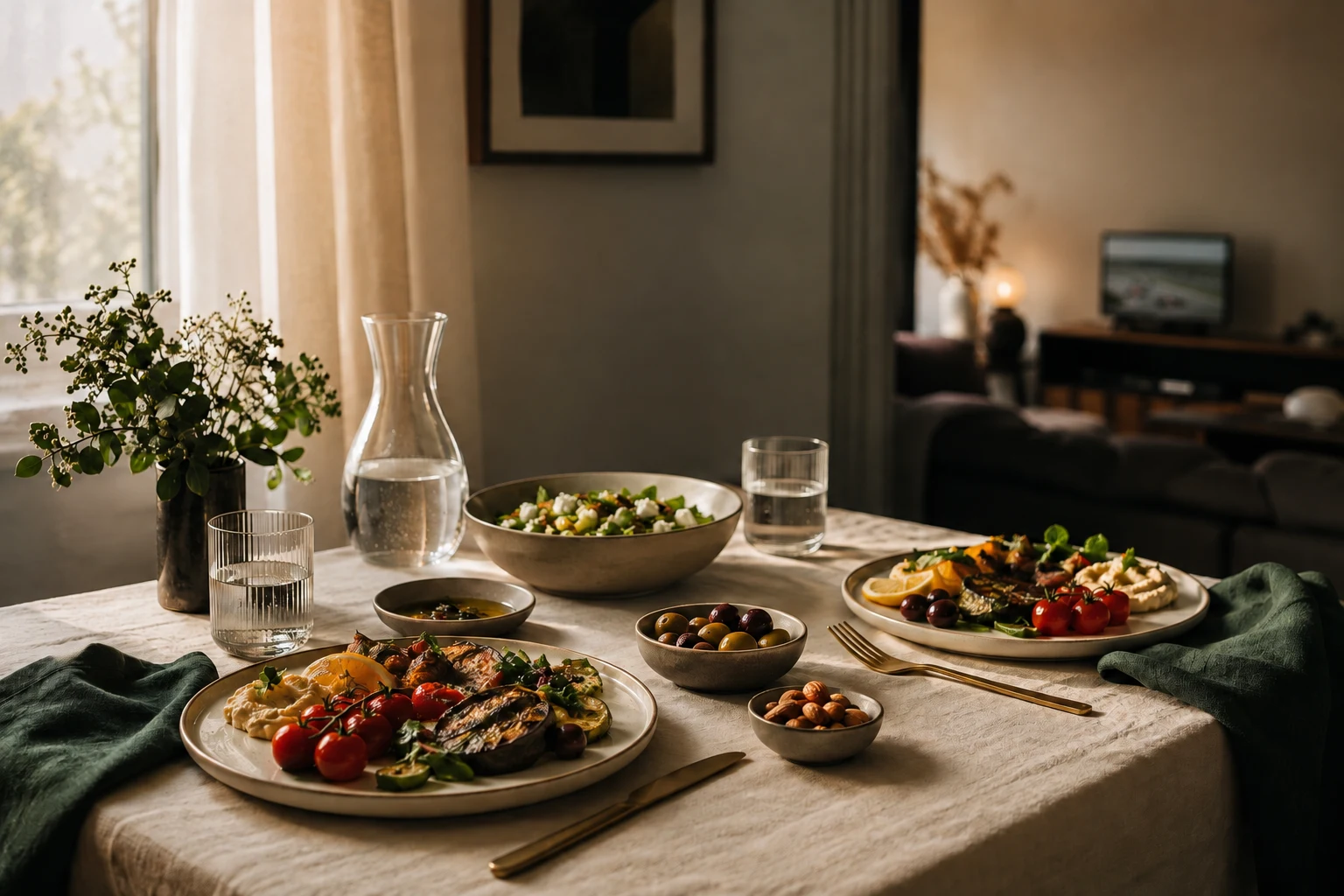
An illustration of our race weekend table. Photos from our own kitchen are on the way.
Our tradition
Wherever the race goes, dinner goes too.
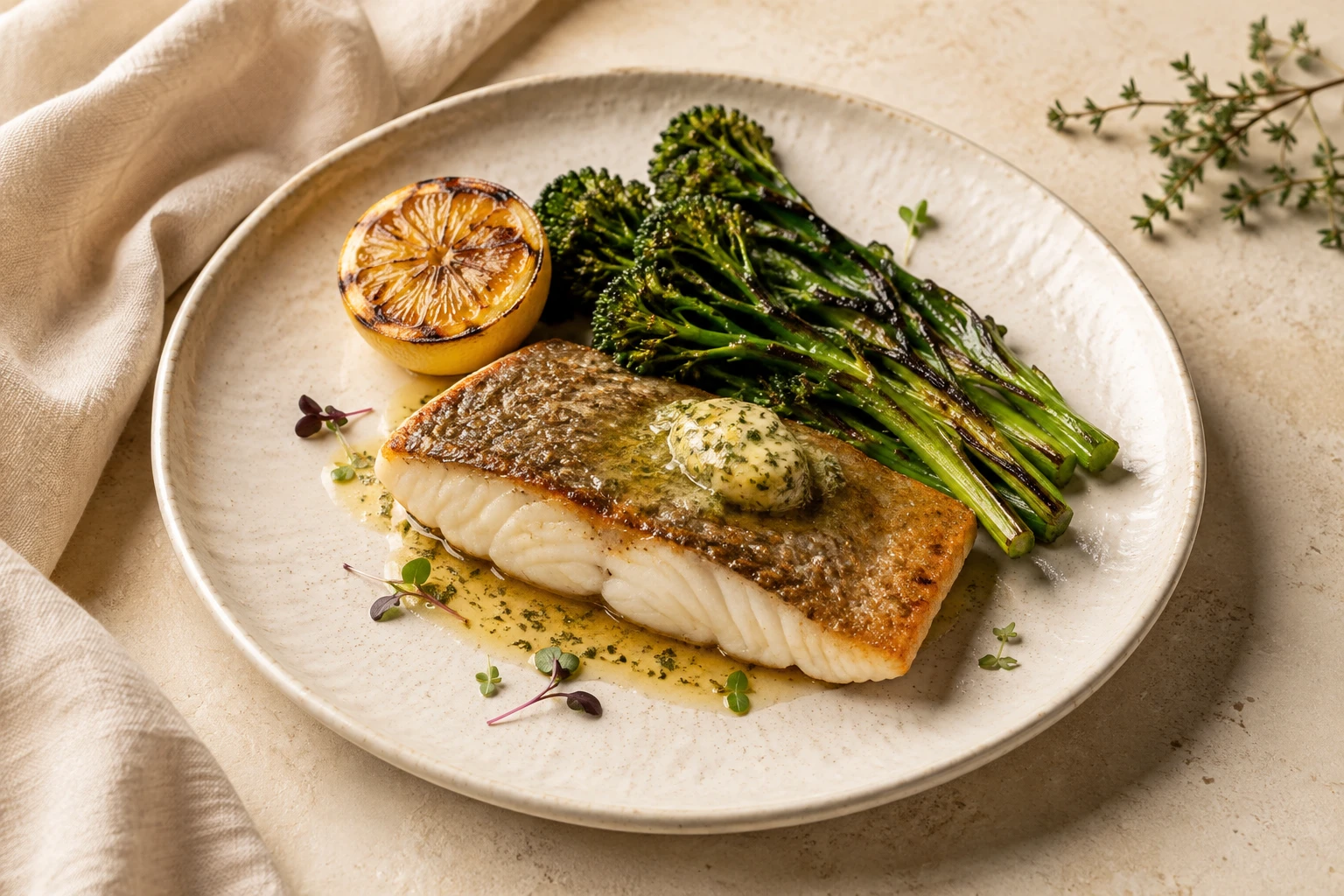
MELBOURNE Barramundi with lemon myrtle butterSHANGHAI Red braised short ribsSUZUKA Teriyaki salmonMONACO BarbajuanMONZA Risotto alla milaneseMEXICO CITY Tacos al pastor
A World, A Menu, A Race Weekend.
Every round opens a new country to taste. In our house, the formation lap doubles as the dinner bell.
The race weekend ritual
Five things, every round.
Discover the destination
Find out where the race is, what surrounds the circuit, and what the locals eat when nobody is filming.
Choose one dish
Pick something that belongs to that place. If you cannot pronounce it yet, even better.
Share the table
Sit down together. The meal is the reason, the company is the reward, and the leftovers are the bonus.
Watch the race
Lights out, plate in hand. Years later, one bite will bring the whole race back, including the parts you would rather forget.
Repeat next round
Next round, a new country. By the finale you have eaten your way around the world without queuing at a single airport.
The first cookbook
The Founders Edition
One chapter for every round of the season. Each one carries you to the host city and home again, with dishes made for an ordinary kitchen and stories worth telling over them.
One thousand copies, numbered and signed by hand. Five hundred hardback, five hundred paperback, and a digital edition for everyone else.
Every dish belongs to the place the race visits, and we research it in the culture it comes from. When a recipe is our own take, we say so, rather than inventing a grandmother we never had.
Written for any kitchen
Every recipe is written so a first time cook can follow it from the chopping board to the plate, with swaps for hard to find ingredients and versions for every kind of diet.
Every fact traced to a source
Dates, results and history are checked against more than one source before they reach a page. The stewards would approve.
Independent and unofficial
We are fans of food and racing. Podium Plates is not connected to Formula 1, the FIA or any team, though we would happily feed all three.
Where the book is todayFirst three chapters drafted
Australia, China and Japan are written. The rest of the season is being researched now.
Be part of it
Pull up a chair with us.
Founders Edition
Buy the cookbook
One thousand numbered and signed copies, from $49.99, and a digital edition at $19.99. Leave your email and you will hear the moment orders open, well before the lights go out.
Pull up a chair with our community of cooks and race fans, and unlock the whole archive back to 1950, for $3 a month.
Every season since 1950, with its story and full results
Every recipe, with its full method, swaps and dietary versions
A race weekend menu with one combined shopping list
Printable recipes and every result for every search
New member features as we add them
Join at $3 and keep that price for as long as you keep your seat. Cancel anytime.
A yearly seat, $99 a year. Everything above, plus each new Podium Plates cookbook sent to you every year, with early access before anyone else. Coming soon
Support our journey
Help a mother and son turn a family tradition into a book worth keeping. Every contribution goes toward researching each chapter and printing the first edition.
One time, from $1
PayPal, Venmo or card
Support is not a preorder or a donation, and is not tax deductible.
Questions
Before you pull up a chair.
What is the Founders Edition?
Our first cookbook, limited to one thousand printed copies: five hundred hardback at $79.99 and five hundred paperback at $49.99, plus shipping. Every printed copy is numbered and signed by both of us, so it comes to us first and then travels on to you, which takes a little longer than an ordinary parcel. The digital edition, at $19.99, is unlimited.
When can I buy the cookbook?
We are writing it now, one chapter per race weekend, which is roughly the pace of the sport itself. Join the list above and you will hear first when orders open.
What is The Podium Table?
The Podium Table is our community of cooks and race fans, and a seat is $3 a month. It opens every season back to 1950, with its story and full results, every recipe with its swaps, dietary versions and shopping list, and every result for every search. Join at $3 and you keep that price for as long as you stay. A yearly seat, coming soon at $99, adds each new cookbook sent to you every year, with early access.
What can I see for free?
Something from everything. Every season has its calendar, its winners and the opening of its story; every race has its top five; every driver, circuit, country and team has its profile; and every country has a signature recipe. The last five seasons and five landmark years are free in full. A seat at The Podium Table adds the rest.
Do I need to follow Formula 1 to use it?
Not at all. The calendar is simply our excuse to travel by plate. Every recipe works perfectly well on a Tuesday, no safety car required.
Where does the race history come from?
The archive is built from Wikidata, a free public database, and checked against the season and race results published on Wikipedia. Every page shows what it was checked against.
Is this an official Formula 1 product?
No. Podium Plates is an independent, unofficial cookbook made by a mother and son. It is not associated with Formula 1, the FIA or any team. We simply cook, very enthusiastically, in their direction.
The race weekend newsletter
Every Grand Prix, in your inbox.
One email a few days before every race: what to cook, the story of the place, the history of the circuit and the drivers who called it home. Free, and as easy to leave as it is to join.
Your next race weekend starts at the table.
Start with this weekend's Grand Prix, or wander any season since 1950. Bring an appetite; we will bring the history.
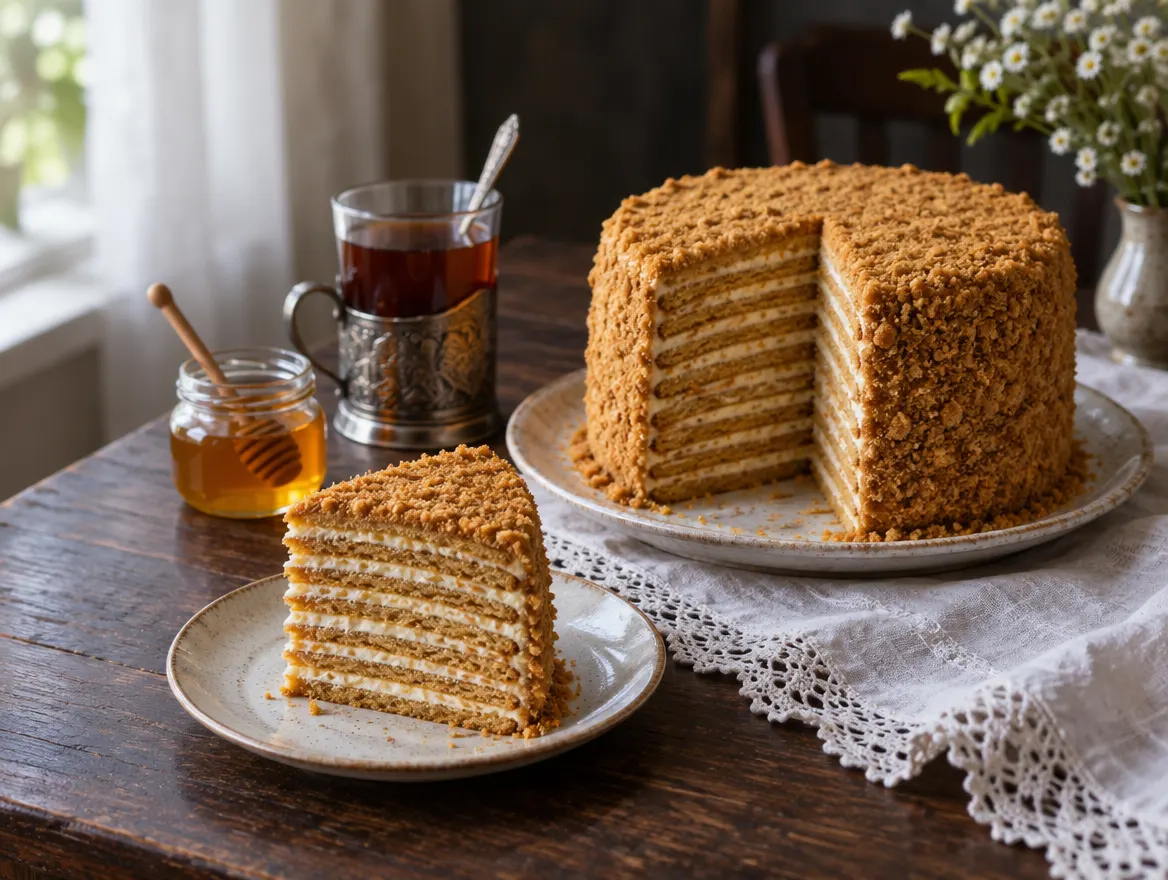
Eight thin, caramel scented honey layers stacked with tangy sour cream frosting and left overnight to soften into a cake that is half sponge, half dream.
Medovik, from med, honey, is the great celebration cake of Russian kitchens: eight or more thin, crisp layers of honey dough, stacked with a sour cream frosting and left overnight, during which the layers drink in the cream and turn soft and tender. Legend says an imperial chef invented it in the nineteenth century to charm an empress who disliked honey, and that she loved it without guessing the secret. Historians note that no cookbook of the period mentions it and that it became famous in the Soviet era; the legend, unbothered, continues to circulate.
It is not a quick cake, but it is a forgiving one, and every step is simple: melt, stir, roll, bake for five minutes, repeat. The reward is a tall slice with fine stripes of gold and cream that tastes of honey and caramel with a gentle tang. It must be made the day before, which makes it the most race weekend friendly dessert in the book: all the work is finished before the lights go out.
The honey layers
Ingredients
1/3 cup (115 g) honey
3/4 cup (150 g) granulated sugar
4 tablespoons (55 g) unsalted butter
3 large eggs
1 teaspoon baking soda
1/4 teaspoon fine salt
3 cups (375 g) all purpose flour
Method
Heat the oven to 375°F (190°C). Put the honey, sugar and butter in the heatproof bowl over the pan of barely simmering water and stir until the butter melts and the sugar has mostly dissolved, about 5 minutes.
Take the bowl off the heat for a minute. Whisking constantly, pour in the beaten eggs in a thin stream so they do not scramble. Put the bowl back over the water and whisk for 2 to 3 minutes.
Whisk in the baking soda and salt and keep whisking over the heat for 1 to 2 minutes.
Take the bowl off the heat and stir in the flour a cup at a time with the spatula. Turn out onto a floured surface and knead briefly until it comes together.
Divide the dough into 8 equal pieces, about the size of a tangerine. Cover them with a bowl so they stay warm and soft.
Put a ball on a parchment square, dust with flour, and roll it into a thin round a little over 9 inches (23 cm) across. Set the template on top and trim around it with the knife, leaving the scraps on the parchment around the circle.
Slide the parchment onto a baking sheet and bake for 5 to 6 minutes. While one bakes, roll the next on the second sheet. Slide each baked layer, still on its parchment, onto a rack. Break off the baked scraps and keep them for the crumbs.
The sour cream frosting
Ingredients
1 cup (240 ml) cold heavy cream
3 cups (720 g) full fat sour cream
1 1/4 cups (150 g) powdered sugar
1 teaspoon vanilla extract
Method
In one large bowl, whip the heavy cream with the electric mixer on medium high for 2 to 3 minutes.
In the other bowl, whisk the sour cream, powdered sugar and vanilla until smooth. Fold in the whipped cream: cut down through the middle with the spatula, lift from the bottom, turn it over the top, and turn the bowl a little each time, until no streaks remain.
Assembly
Ingredients
Method
Dab a spoon of frosting on the cake plate and set the first layer on it. Spread about 1/2 cup (120 ml) frosting evenly over it, right to the edge. Repeat with the remaining layers, pressing each gently into place, ending with a layer. Choose the flattest layer for the top.
Spread the remaining frosting over the top and sides in a smooth layer.
Grind the baked scraps to fine crumbs in the food processor, or crush them in the bag with the rolling pin. Press the crumbs over the top and sides with your palm.
Cover loosely and refrigerate for at least 8 hours, ideally 10 to 12.






 Coming soon