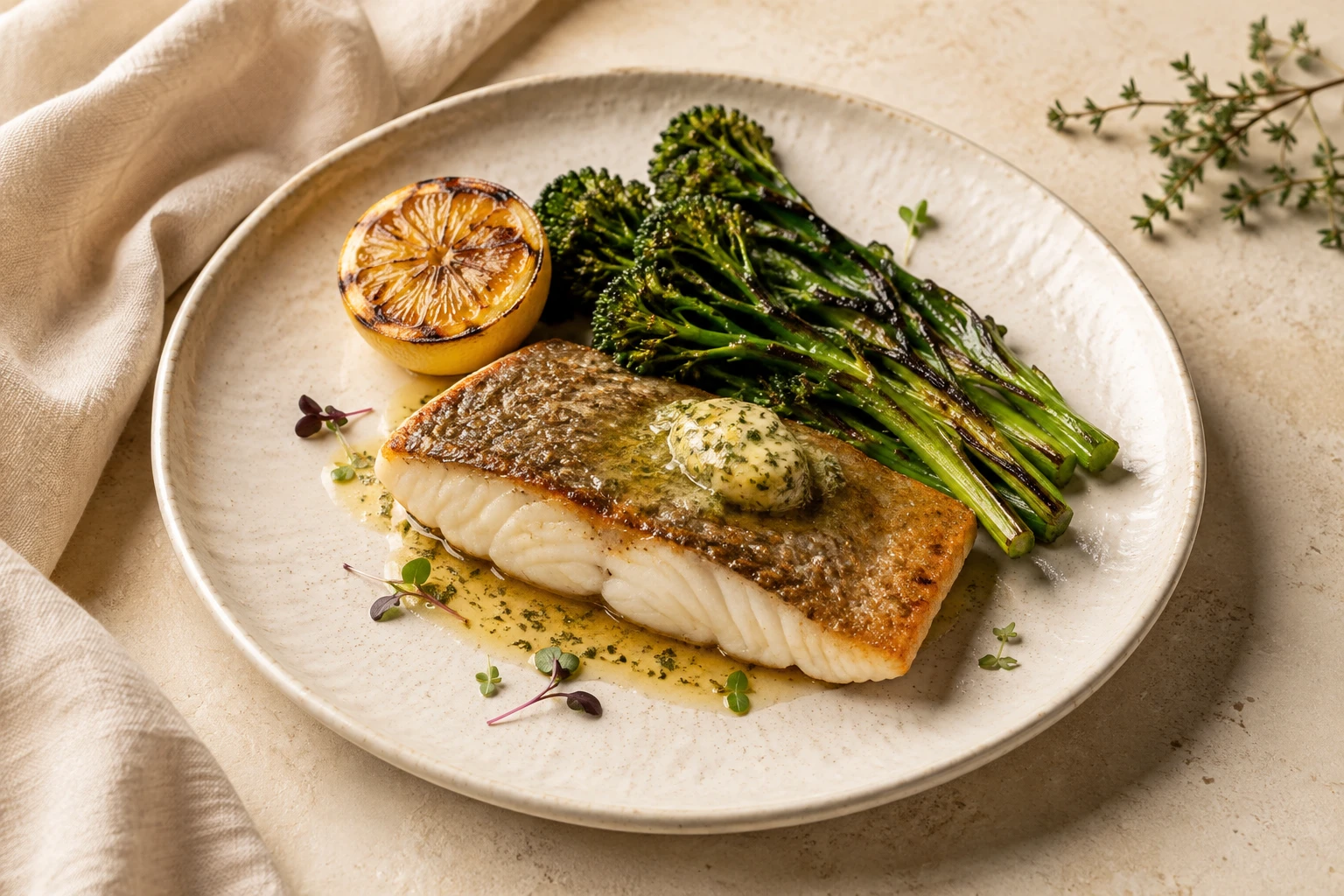
Travel the Formula 1 calendar from your own kitchen. Search any driver, circuit, country or race since 1950, then bring that place to your table. No passport required, though an apron helps.
Every driver leads to a country, every country to a circuit, and every circuit, eventually, to dinner.
Where it began
My mom and I.
Every race, a seat at our table.
For almost a decade, my mom and I have kept one tradition. Wherever Formula 1 races that weekend, that is where dinner comes from. Melbourne sends us to the Australian coast. Suzuka brings Japan into our kitchen. Monza means Italy, and a very long lunch.
What began as a way to watch together became the best part of our week. A country we have never visited. An ingredient we have never bought. An hour side by side at the stove before the lights go out. Somewhere between the first course and the checkered flag, it stopped being dinner and became ours.
For years we joked that it should be a cookbook. Now we are writing it, together, one race at a time.
Podium Plates is more than a book to us. It is a reason to keep building something side by side, to keep learning the places we have only seen on a screen, and to follow this sport a little closer with every season. Support it, and you are not only backing a cookbook. You are pulling up a chair at our table, and coming along for whatever comes next.
Every contribution goes toward researching, writing and printing the first edition.
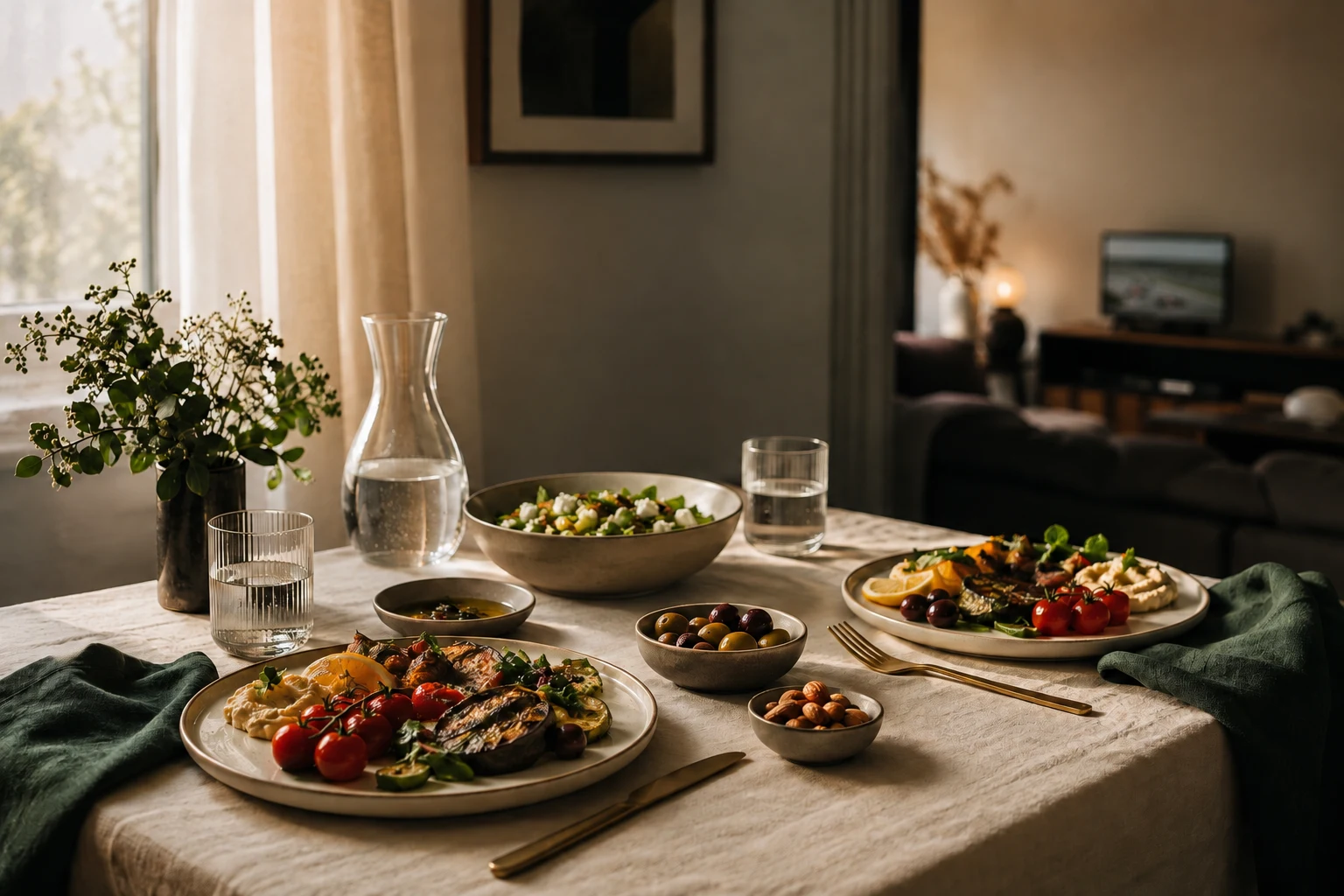
An illustration of our race weekend table. Photos from our own kitchen are on the way.
Our tradition
Wherever the race goes, dinner goes too.
MELBOURNE Barramundi with lemon myrtle butterSHANGHAI Red braised short ribsSUZUKA Teriyaki salmonMONACO BarbajuanMONZA Risotto alla milaneseMEXICO CITY Tacos al pastor
A World, A Menu, A Race Weekend.
Every round opens a new country to taste. In our house, the formation lap doubles as the dinner bell.
The race weekend ritual
Five things, every round.
Discover the destination
Find out where the race is, what surrounds the circuit, and what the locals eat when nobody is filming.
Choose one dish
Pick something that belongs to that place. If you cannot pronounce it yet, even better.
Share the table
Sit down together. The meal is the reason, the company is the reward, and the leftovers are the bonus.
Watch the race
Lights out, plate in hand. Years later, one bite will bring the whole race back, including the parts you would rather forget.
Repeat next round
Next round, a new country. By the finale you have eaten your way around the world without queuing at a single airport.
The first cookbook
The Founders Edition
One chapter for every round of the season. Each one carries you to the host city and home again, with dishes made for an ordinary kitchen and stories worth telling over them.
One thousand copies, numbered and signed by hand. Five hundred hardback, five hundred paperback, and a digital edition for everyone else.
Every dish belongs to the place the race visits, and we research it in the culture it comes from. When a recipe is our own take, we say so, rather than inventing a grandmother we never had.
Written for any kitchen
Every recipe is written so a first time cook can follow it from the chopping board to the plate, with swaps for hard to find ingredients and versions for every kind of diet.
Every fact traced to a source
Dates, results and history are checked against more than one source before they reach a page. The stewards would approve.
Independent and unofficial
We are fans of food and racing. Podium Plates is not connected to Formula 1, the FIA or any team, though we would happily feed all three.
Where the book is todayFirst three chapters drafted
Australia, China and Japan are written. The rest of the season is being researched now.
Be part of it
Pull up a chair with us.
Founders Edition
Buy the cookbook
One thousand numbered and signed copies, from $49.99, and a digital edition at $19.99. Leave your email and you will hear the moment orders open, well before the lights go out.
Pull up a chair with our community of cooks and race fans, and unlock the whole archive back to 1950, for $3 a month.
Every season since 1950, with its story and full results
Every recipe, with its full method, swaps and dietary versions
A race weekend menu with one combined shopping list
Printable recipes and every result for every search
New member features as we add them
Join at $3 and keep that price for as long as you keep your seat. Cancel anytime.
A yearly seat, $99 a year. Everything above, plus each new Podium Plates cookbook sent to you every year, with early access before anyone else. Coming soon
Support our journey
Help a mother and son turn a family tradition into a book worth keeping. Every contribution goes toward researching each chapter and printing the first edition.
One time, from $1
PayPal, Venmo or card
Support is not a preorder or a donation, and is not tax deductible.
Questions
Before you pull up a chair.
What is the Founders Edition?
Our first cookbook, limited to one thousand printed copies: five hundred hardback at $79.99 and five hundred paperback at $49.99, plus shipping. Every printed copy is numbered and signed by both of us, so it comes to us first and then travels on to you, which takes a little longer than an ordinary parcel. The digital edition, at $19.99, is unlimited.
When can I buy the cookbook?
We are writing it now, one chapter per race weekend, which is roughly the pace of the sport itself. Join the list above and you will hear first when orders open.
What is The Podium Table?
The Podium Table is our community of cooks and race fans, and a seat is $3 a month. It opens every season back to 1950, with its story and full results, every recipe with its swaps, dietary versions and shopping list, and every result for every search. Join at $3 and you keep that price for as long as you stay. A yearly seat, coming soon at $99, adds each new cookbook sent to you every year, with early access.
What can I see for free?
Something from everything. Every season has its calendar, its winners and the opening of its story; every race has its top five; every driver, circuit, country and team has its profile; and every country has a signature recipe. The last five seasons and five landmark years are free in full. A seat at The Podium Table adds the rest.
Do I need to follow Formula 1 to use it?
Not at all. The calendar is simply our excuse to travel by plate. Every recipe works perfectly well on a Tuesday, no safety car required.
Where does the race history come from?
The archive is built from Wikidata, a free public database, and checked against the season and race results published on Wikipedia. Every page shows what it was checked against.
Is this an official Formula 1 product?
No. Podium Plates is an independent, unofficial cookbook made by a mother and son. It is not associated with Formula 1, the FIA or any team. We simply cook, very enthusiastically, in their direction.
The race weekend newsletter
Every Grand Prix, in your inbox.
One email a few days before every race: what to cook, the story of the place, the history of the circuit and the drivers who called it home. Free, and as easy to leave as it is to join.
Your next race weekend starts at the table.
Start with this weekend's Grand Prix, or wander any season since 1950. Bring an appetite; we will bring the history.
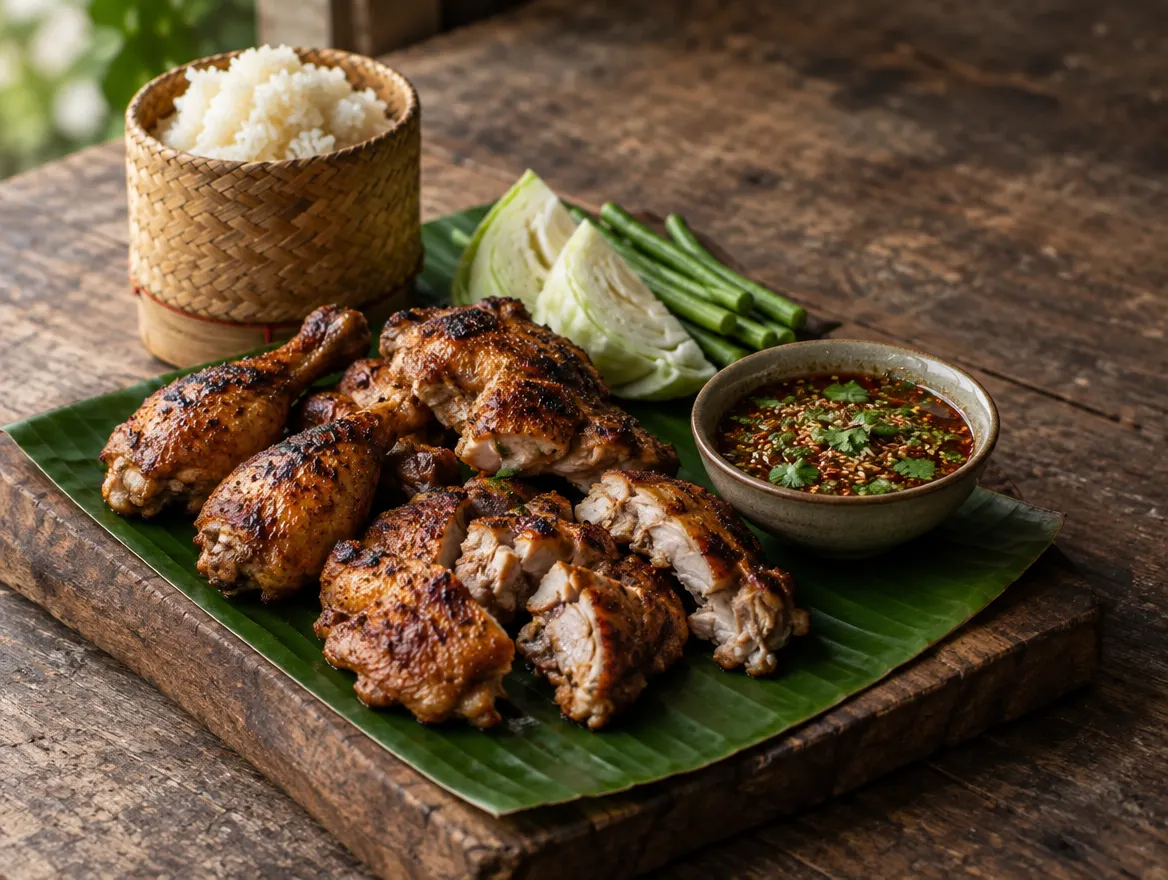
Chicken legs marinated in garlic, lemongrass, coriander root and pepper, grilled slowly until bronzed, with a sour, smoky dipping sauce of tamarind, chili and toasted rice.
Gai yang, grilled chicken, belongs to the shared kitchen of Laos and Isan, Thailand's northeast, and it is now sold from street grills across the whole country. The marinade is pounded from garlic, lemongrass, coriander root and plenty of pepper, seasoned with fish sauce and a little sugar, and the chicken is cooked slowly over low coals so the skin turns a deep bronze while the meat stays juicy. It is a dish of patience: the grill cooks do very little, very attentively, for a long time.
The partner it cannot do without is nam jim jaew, a thin, sour, smoky dipping sauce of tamarind, lime, fish sauce, dried chili and toasted ground rice, which gives it a nutty, sandy texture. With som tam and a basket of sticky rice it makes the classic Isan meal, a fine thing to eat while watching the motorcycles at Buriram or a Grand Prix from the sofa.
The marinated chicken
Ingredients
3 lb (1.4 kg) bone in, skin on chicken thighs and drumsticks
8 garlic cloves
2 stalks lemongrass
2 tablespoons cilantro roots or stems
2 teaspoons white or black peppercorns
3 tablespoons (45 ml) fish sauce
1 tablespoon (15 ml) light soy sauce
1 tablespoon palm sugar
2 tablespoons (30 ml) vegetable oil
Method
Pound the peppercorns in the mortar until coarsely cracked. Add the garlic, lemongrass and cilantro roots and pound for 3 to 4 minutes into a rough paste. In a mini food processor, blend everything with the oil instead.
Scrape the paste into the large bowl and stir in the fish sauce, soy sauce, palm sugar and oil until the sugar has mostly dissolved.
Pat the chicken dry with paper towels. Cut two or three slashes about 1/2 inch (1 cm) deep into the meaty side of each piece, down to the bone. Add the chicken to the marinade and rub it into the slashes and under the skin with your hands. Cover and refrigerate for at least 4 hours or overnight, turning once if you remember. Wash your hands well.
For a charcoal grill, pile the lit coals on one side so you have a hot side and a cooler side. For gas, light one side on medium and leave the other side off. For the oven, heat it to 400°F (200°C) and set the wire rack on the foil lined baking sheet.
Scrape most of the loose paste off the chicken, as bits of garlic burn. Rub the grate with a little oil. Grill the chicken skin side up on the cooler side with the lid closed for 30 to 40 minutes, turning every 10 minutes and brushing with the leftover marinade during the first 20 minutes only. Finish skin side down over the hotter side for 2 to 3 minutes to crisp. In the oven, roast skin side up on the rack for 35 to 45 minutes, then broil for 2 to 3 minutes for color.
Rest the chicken on a board for 5 minutes, then chop each thigh into 2 or 3 pieces through the bone with a heavy knife if you like, as Thai vendors do.
Nam jim jaew dipping sauce
Ingredients
2 tablespoons uncooked glutinous rice
3 tablespoons (45 ml) fish sauce
2 tablespoons (30 ml) fresh lime juice
1 tablespoon (15 ml) tamarind concentrate
2 teaspoons palm sugar
1 to 2 teaspoons dried chili flakes
1 small shallot
2 tablespoons cilantro leaves
1 scallion
Method
Put the raw rice in the dry skillet over medium low heat and stir or shake the pan often for 8 to 10 minutes. Let it cool for 2 minutes, then grind it to a coarse powder in the spice grinder or mortar.
In the small bowl, stir the fish sauce, lime juice, tamarind and palm sugar until the sugar dissolves. Stir in the chili flakes and shallot.
Just before serving, stir in 1 tablespoon of the toasted rice powder, the cilantro and the scallion. Keep the leftover rice powder in a jar for next time.







 Coming soon