Dressed for the paddock.Priced for the grandstand.
Travel the Formula 1 calendar from your own kitchen. Search any driver, circuit, country or race since 1950, then bring that place to your table. No passport required, though an apron helps.
Every driver leads to a country, every country to a circuit, and every circuit, eventually, to dinner.
This race weekend
Where it began
A mother and son.
A world of tradition at our table.
Podium Plates brings together two passions: my mother's love of cookbooks and my love of Formula 1.
Over years of travel, she built a collection of cookbooks from around the world, while I have followed Formula 1 for many years. When we began watching the races together, we started to wonder what it would be like to cook a meal from wherever the race was being held that weekend.
Her collection made that possible, and what began as a single meal soon became a tradition. For years we joked about turning it into a cookbook that follows the Formula 1 season, and eventually we decided to make it real.
Podium Plates is our way of sharing that tradition with others. For every race, we research the location, the circuit, the drivers and the local food, so that anyone can bring the race weekend to their own table.
We make it independently, as a mother and son, and we hope to continue it with a new edition every season.
Every contribution goes toward researching, writing and printing the first edition.
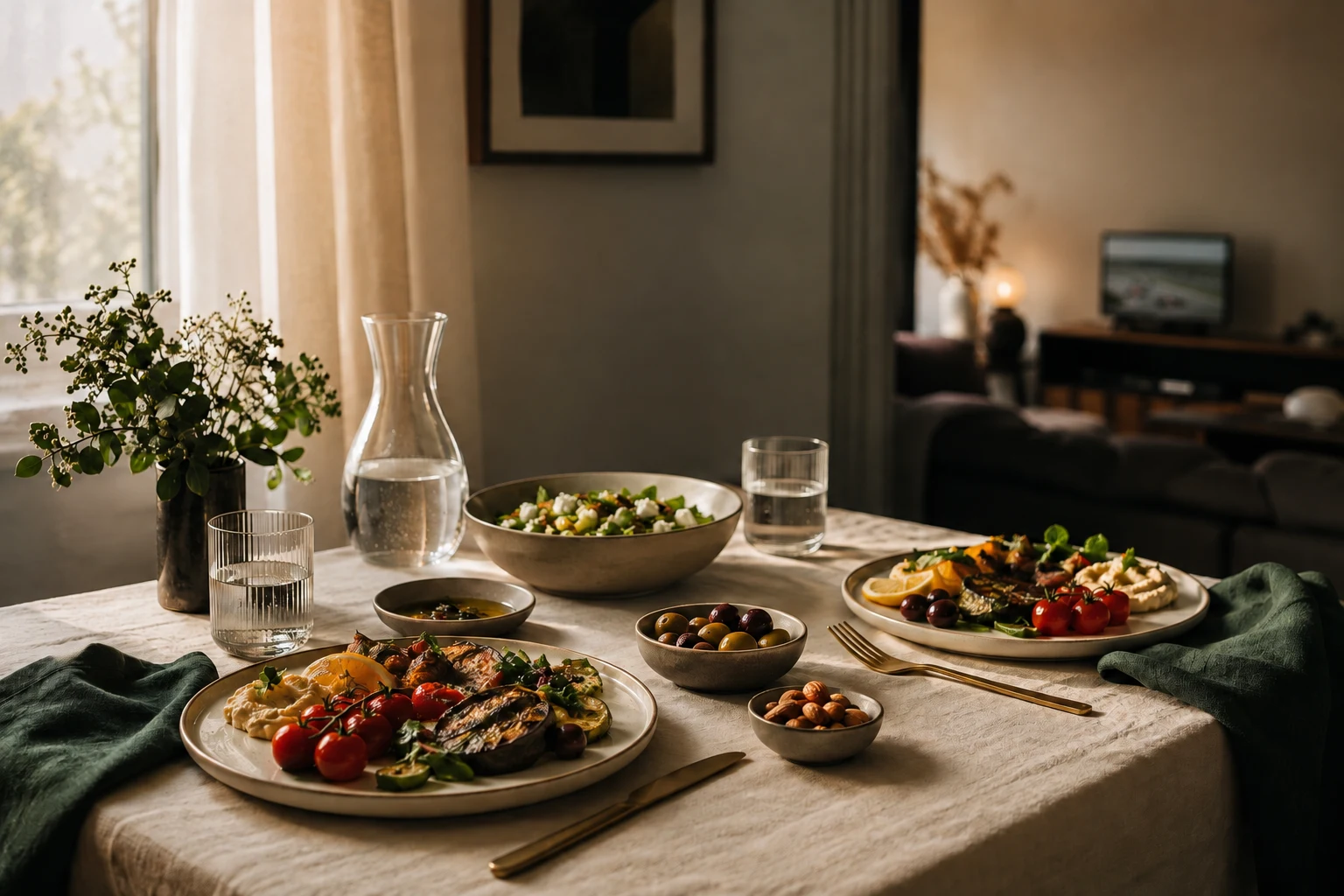
An illustration of our race weekend table. Photos from our own kitchen are on the way.
Our tradition
Wherever the race goes, dinner goes too.
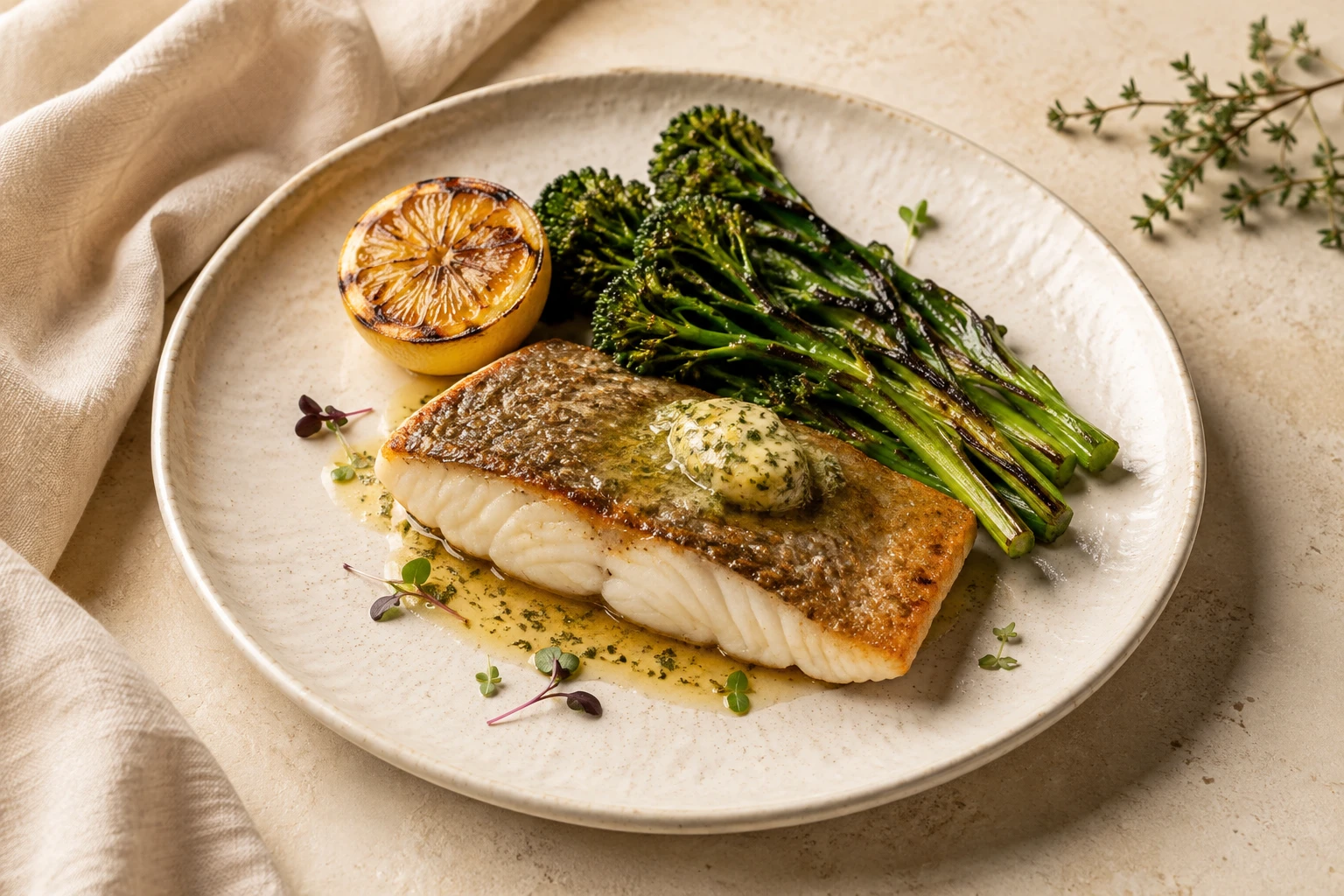
MELBOURNE Barramundi with lemon myrtle butterSHANGHAI Red braised short ribsSUZUKA Teriyaki salmonMONACO BarbajuanMONZA Risotto alla milaneseMEXICO CITY Tacos al pastor
A World, A Menu, A Race Weekend.
Every round opens a new country to taste. In our house, the formation lap doubles as the dinner bell.
The race weekend ritual
Five things, every round.
Discover the destination
Find out where the race is, what surrounds the circuit, and what the locals eat when nobody is filming.
Choose one dish
Pick something that belongs to that place. If you cannot pronounce it yet, even better.
Share the table
Sit down together. The meal is the reason, the company is the reward, and the leftovers are the bonus.
Watch the race
Lights out, plate in hand. Years later, one bite will bring the whole race back, including the parts you would rather forget.
Repeat next round
Next round, a new country. By the finale you have eaten your way around the world without queuing at a single airport.
The first cookbook
The Founders Edition
One chapter for every round of the season. Each one carries you to the host city and home again, with dishes made for an ordinary kitchen and stories worth telling over them.
One thousand copies, numbered and signed by hand. Five hundred hardback, five hundred paperback, and a digital edition for everyone else.
Every dish belongs to the place the race visits, and we research it in the culture it comes from. When a recipe is our own take, we say so, rather than inventing a grandmother we never had.
Written for any kitchen
Every recipe is written so a first time cook can follow it from the chopping board to the plate, with swaps for hard to find ingredients and versions for every kind of diet.
Every fact traced to a source
Dates, results and history are checked against more than one source before they reach a page. The stewards would approve.
Independent and unofficial
We are fans of food and racing. Podium Plates is not connected to Formula 1, the FIA or any team, though we would happily feed all three.
Where the book is todayFirst three chapters drafted
Australia, China and Japan are written. The rest of the season is being researched now.
Be part of it
Pull up a chair with us.
Founders Edition
Buy the cookbook
One thousand numbered and signed copies, from $49.99, and a digital edition at $19.99. Leave your email and you will hear the moment orders open, well before the lights go out.
Pull up a chair with our community of cooks and race fans, and unlock the whole archive back to 1950, for $3 a month.
Every season since 1950, with its story and full results
Every recipe, with its full method, swaps and dietary versions
A race weekend menu with one combined shopping list
Printable recipes and every result for every search
New member features as we add them
Join at $3 and keep that price for as long as you keep your seat. Cancel anytime.
A yearly seat, $99 a year. Everything above, plus each new Podium Plates cookbook sent to you every year, with early access before anyone else. Coming soon
Support our journey
Help a mother and son turn a family tradition into a book worth keeping. Every contribution goes toward researching each chapter and printing the first edition.
One time, from $1
PayPal, Venmo or card
Support is not a preorder or a donation, and is not tax deductible.
Questions
Before you pull up a chair.
What is the Founders Edition?
Our first cookbook, limited to one thousand printed copies: five hundred hardback at $79.99 and five hundred paperback at $49.99, plus shipping. Every printed copy is numbered and signed by both of us, so it comes to us first and then travels on to you, which takes a little longer than an ordinary parcel. The digital edition, at $19.99, is unlimited.
When can I buy the cookbook?
We are writing it now, one chapter per race weekend, which is roughly the pace of the sport itself. Join the list above and you will hear first when orders open.
What is The Podium Table?
The Podium Table is our community of cooks and race fans, and a seat is $3 a month. It opens every season back to 1950, with its story and full results, every recipe with its swaps, dietary versions and shopping list, and every result for every search. Join at $3 and you keep that price for as long as you stay. A yearly seat, coming soon at $99, adds each new cookbook sent to you every year, with early access.
What can I see for free?
Something from everything. Every season has its calendar, its winners and the opening of its story; every race has its top five; every driver, circuit, country and team has its profile; and every country has a signature recipe. The last five seasons and five landmark years are free in full. A seat at The Podium Table adds the rest.
Do I need to follow Formula 1 to use it?
Not at all. The calendar is simply our excuse to travel by plate. Every recipe works perfectly well on a Tuesday, no safety car required.
Where does the race history come from?
The archive is built from Wikidata, a free public database, and checked against the season and race results published on Wikipedia. Every page shows what it was checked against.
Is this an official Formula 1 product?
No. Podium Plates is an independent, unofficial cookbook made by a mother and son. It is not associated with Formula 1, the FIA or any team. We simply cook, very enthusiastically, in their direction.
The race programme
Every Grand Prix, in your inbox.
A few days before every Grand Prix: the circuit and what makes a lap there, who has won before, the storylines and the standings, and a menu from the host country to cook while you watch. Free, and as easy to leave as it is to join.
Your next race weekend starts at the table.
Start with this weekend's Grand Prix, or wander any season since 1950. Bring an appetite; we will bring the history.
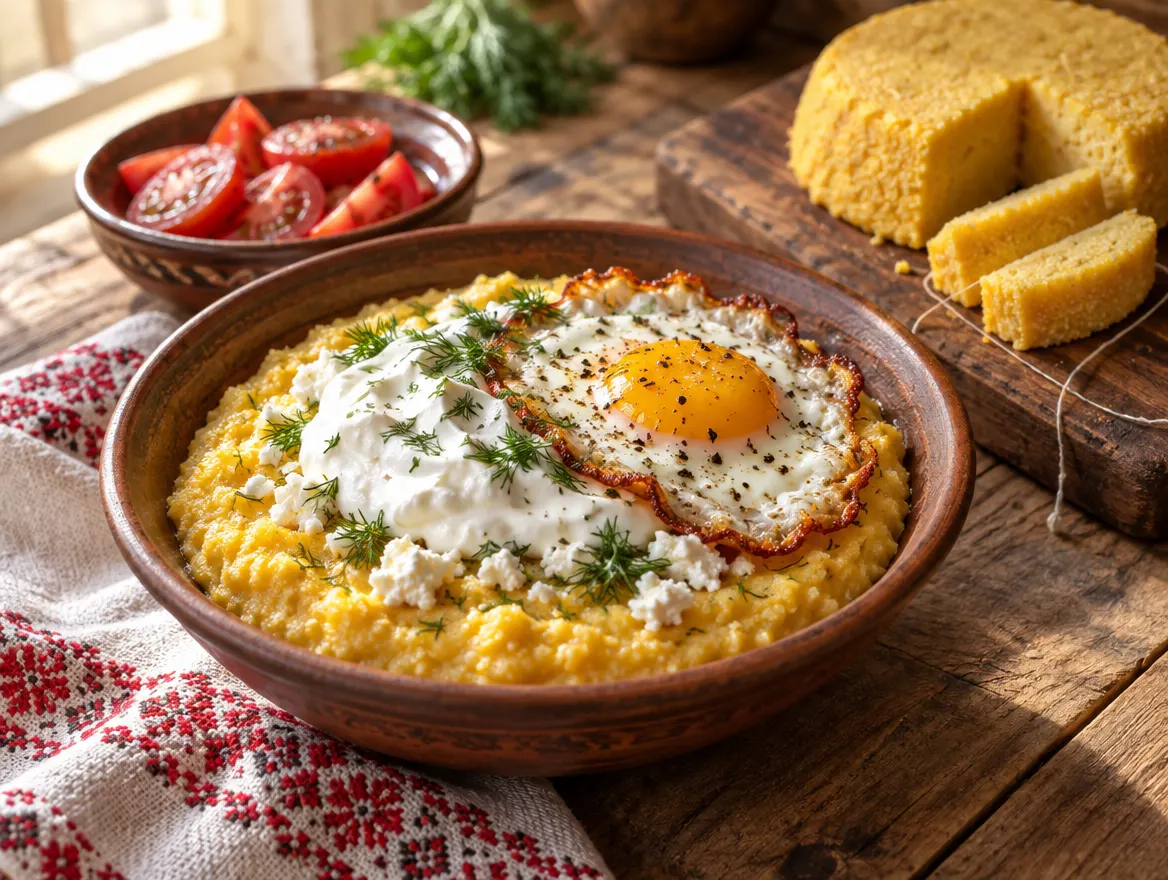
Golden cornmeal mămăligă with salty cheese, sour cream and a fried egg
Thick, golden mămăligă stirred from cornmeal, water and salt, spooned into warm bowls with crumbled salty white cheese and cold sour cream, then crowned with a fried egg whose yolk runs into everything.
Mămăligă is the cornmeal dish Romania grew up on. Long before maize crossed the Atlantic it was made from millet, and once corn reached the region it became the food that carried country families through hard years, standing in for bread on tables where wheat was scarce or taxed. It is cooked thicker than most Italian polenta, so firm that it is traditionally turned out onto a wooden board and cut with a length of thread, because it clings to a knife with real determination.
The affectionate diminutive, mămăliguță, is reserved for the version people dream about: hot mămăligă with crumbled salty cheese and a cold spoonful of smântână, the thick Romanian sour cream, often with a fried egg on top. It is peasant food that has graduated to restaurant menus without changing its clothes, and it costs almost nothing to make. The cheese melts at the edges, the sour cream cools each mouthful, and the yolk turns the whole bowl into something richer than the sum of four humble ingredients.
It is also an ideal first Romanian dish to explore at home: one pot, one spoon and half an hour, finished well before the formation lap.
The mămăligă
Ingredients
4 1/2 cups (1.1 liters) water
1 1/2 teaspoons fine salt
2 tablespoons (30 g) unsalted butter
1 1/2 cups (250 g) yellow cornmeal
Method
Pour the water into the heavy pot, add the salt and 1 tablespoon of the butter, and bring it to a full boil over high heat.
Take a small handful of the cornmeal, about 2 tablespoons, and let it fall slowly through your fingers into the boiling water while you whisk. This thin first addition keeps the rest from clumping. Let it come back to the boil.
Turn the heat down to medium. Pour in the remaining cornmeal in a slow, steady stream with one hand while you whisk constantly with the other. Keep whisking for 2 minutes after the last of it goes in, chasing out any lumps against the side of the pot.
Switch to the wooden spoon and turn the heat to low. Cover the pot, leaving the lid slightly open, and cook for 25 to 30 minutes, stirring firmly every 3 or 4 minutes and scraping the bottom and corners. If it becomes too stiff to stir before the time is up, add hot water from the kettle 2 tablespoons at a time.
Taste a little from the spoon, letting it cool first. It is cooked when it tastes smooth and sweet rather than gritty. Stir in the remaining tablespoon of butter.
The fried eggs
Ingredients
1 tablespoon (15 g) butter or sunflower oil
4 large eggs
1 pinch salt and freshly ground black pepper
Method
While the mămăligă has its last 5 minutes, melt the butter in the frying pan over medium heat.
Crack the eggs into the pan, spacing them apart. Season with salt and pepper. Cook for 2 minutes, then cover with the lid for 1 minute more so the tops set while the yolks stay soft.
To assemble
Ingredients
7 oz (200 g) telemea or brânză de burduf
1 cup (240 g) smântână
1 tablespoon chopped dill or chives
Method
Spoon a generous layer of hot mămăligă into each warm bowl. Scatter over half the crumbled cheese, then add a second spoonful of mămăligă and the rest of the cheese, so the cheese softens between the layers.
Top each bowl with a big spoonful of cold sour cream and slide a fried egg on top. Add a grind of pepper and a little dill if you like, and serve at once.
To serve it the old way, cook the mămăligă 5 minutes longer so it is very firm, then turn the pot upside down onto the wooden board in one confident movement. Let it settle for 2 minutes. Slip the thread under the round, cross the ends over the top and pull them apart to cut clean slices. Serve the slices with the cheese, sour cream and eggs alongside.


 Coming soon